5.20.2019

In Memoriam: MALARTS

“Concentration on creation is my daily operation /
It’s a mission coming up a Nubian within this nation”
- PS Chase, "Now Power"

If you ever once to hear me DJ and were so kind to thought I was cool, it is entirely because of Malcolm Little.

Malcolm blessed me with my tag and DJ name ARM 18. Just my initials and age at the time- it had an old school TAKI 183 feel to it. But like the sticker he put it to, it stuck. Because long before I ever did, Malcolm believed in me.

Mal, Moods, Public Speaker, Chase, IndyMal, MalArts et al was a true blue Renaissance man, a travellin’ man; a sci-fi afro punk artist-in-residence, perpetually on the move, like a rolling stone, but who most often called Staten Island home. We met in the summer of 1993 in upstate NY at Bard College and immediately set off on adventurers with our fellow mad ones, “the ones who are mad to live, mad to talk, mad to be saved, desirous of everything at the same time, the ones who never yawn or say a commonplace thing.” Malcolm was mad in this way and became our unassuming fearless spiritual leader: General of the Love Army International, Outback Master, clutch hitting outfielder for the Easy Living Krew.

“Get into mastery of self not mastery of men /
I keep a whole mess of fam but very few true friends”
- PS Chase, "Now Power"

Malcolm rolled deep, but to know him you had to accept he was decidedly an enigmatic loner. Nonetheless, he was seemingly a friend and ally to many, having a rich personal history that touched all five boroughs and beyond. His smile and kindness were a strength not to be underestimated.

Nor was his intolerance for herbs, bullshit and injustice. When Malcolm was in your presence, it was time to build and destroy, activate and motive, blow up the spot. He owned a kinetic intellect; for Malcolm, theories and experiences were one in the same, he seized the moment with a loving death grip in order to know the ledge.

“Programmed with the man with the hat and the tan /
Captain Chase throw another phat style in the can”
- PS Chase, "Now Power"

Malcolm could drop science without a lecture. There’s an effortlessness to his affective artistry found in the dozens of mediums he utilized: spray cans, blackbooks, canvas, graphic design, film, guitars, drums, samplers, a jean jacket, a pad and a pen, to name but a few. Mal was also a prop master, never without a go-go gadget: a Sharpie, a skateboard, a microphone, a camera, a lighter, a flower.

He possessed the gift of gab, the poetics of a statement as significant as the idea. Speaking upon racism: “And therein lies the tragedy, a kind of fucked up form of perfection.” He could speak upon Marshall McLuhan, McCoy Tyner or Malcolm McLaren with verve, ease and expertise. Malcolm took a phrase rarely heard, flip it and it became our daily word: parlay, tical, maintain, true, fam, audio goldrush, stereo moonrise, dub lodge, the Tragic NorthEast.


“As my city’s sinking time to jump in the life boat /
stay fluid with thoughts and action, jack, that will keep hope”
- PS Chase, "Open Wide (Approaching Terra Nova)"

With Malcolm, we were always on a “mission”. We trekked through a foot of snow in the Catskills and discovered an abandoned Fresh Air Fund tennis camp seemingly sealed in time, each cabin a treasure trove of 1970s memorabilia; with 7,000 other NY state college students, Malcolm stormed Albany’s capital center in protest of Pataki’s proposed 1995 budget cuts in higher ed for the underprivileged; at a 1999 spring fair, I cut up break beats in front of confused Lehigh University students as Malcolm chose not to rhyme on the mic but break out his harmonica and blow like Bobby Dylan. Don't think twice, he winked, it's alright.

He was the first person who taught us that you could choose your own family, my freshman year roommate “Matt Kenny” recalled. “So many memories I have of him involve intimate conversations that took place amid noise and activity. But it was easy to feel like you were alone on an island with Malcolm, exploring underlying reasons for the failures of the past and present, plotting how to make the future much, much better.” When finishing an immense mural that blended science fiction with 60s counter culture psychedelia in Bard’s Old Gym, he considered his work and remarked, “In this world, even love needs an army.”


He commissioned me ARM 18 and called my DJ sets the “dream scene”. Being “named” not only felt like an honor, but a duty. I wasn't alone in receiving such a gift, the disciples he never asked for were the beneficiaries of his magnanimity as well. In friendship, Malcolm expressed loyalty by pushing you to be more, encouraging you to remix yourself as much as possible in order to produce, create, innovate on a higher level. We would find comfort in our skin if we continued to shed it.

Malcolm, you selflessly gave so much to me right up until your last weekend: vision, encouragement, playfulness. I just want to quit DJing now and shut it down but I hear your voice applauding me on: “ARM One Eight flip the plate / it’s time to make perfect blends / because all this hip shit needs to hop now and then”

Peace, akhi. Your work will not go unheard, unrecognized or unseen. Immaletemknow.

And Mal, I apologize, sincerely. It felt like you shared with me everything but the burden. I offer all my love, utmost respect and am eternally grateful. I hope I am what you expected.


10.15.2014

Legends of the Fall 1994

"No time for looking back, it's done"

Like 1979, 1982, 1988 or 1997, any working chronology of Hip Hop music should never overlook 1994 as a pinnacle year of its development, especially for New York.  Knowledgeable heads will cite Nas’ Illmatic and Notorious BIG’s Ready to Die with just cause.  Those less provincial will note Snoop Doggy Dogg’s solo album, Common’s resurrection of Chicago and Outkast’s debut from Atlanta.  Strikingly, Fall 1994 Hip Hop is a period that sounds both dated and inventive.  It is a moment when old school sensibilities of rocking mics mixed with a menace inflicted by a box cutter’s blade.  

The mixtapes Legends of the Fall 1994 (aka "When We Were Very Young") Volumes One, Two and Three captures both the pleasure and pain of this period. MP3 mixes are zipped up and Apple Music friendly by yours truly. You can also find this mix in Spotify here in Volumes One, Two and Three. Or in Apple Music playlists here in Volumes One, Two and Three.

"A strange form,
somethin' kind of lyrical"
By that autumn, the serendipitous creativity and commercial growth of rap music from 1986 to 1993 was coming to close.  1994 was, in some ways, the Golden Era’s wake.  These songs were brutal lyrical laments of a transformative and uplifting street culture passing away.  Moreover, raps of this era chronicle the impact of the crack cocaine epidemic on the black American urban underclass unflinchingly.  These kids grew up on Planet Ready Rock where the lines between the rap game and crack game had blurred.  The impact of the latter loomed too large to ignore evidenced by unflinching titles such as “Shook Ones” or “Stray Bullet.”

No doubt Nas' epic “One Love” or declarative “Life’s a Bitch” may be the best of these moments.  But Lord Finesse’s “Shorties Kaught in the System” or Rae and Ghost’s “Heaven and Hell” also capture a growing dread that things done changed.  The youth of the late 1980s and 1990s have been abandoned not only by systemic inequality of the Reagan years but familial rejection.  "Ready to die, why I act that way? / Pop Duke left Mom Duke, the faggot took the back way” Biggie scorns on “The What.”  

"You see it, I be it"
Songs such as “Downtown Swinga,” “Buck ‘em Down” and “Let’s Get It On” all capture a confrontational, uncompromising stance: alienated urban black youth who casually flash steel, blow trees and guzzle Hennessy as a means of opposition for anyone within or outside their cypher that encroach upon their block.  “The most violent of the violent-lest crimes we give life to / If these QueensBridge kids don't like you” Prodigy intones on “Shook Ones.”

Friends are no allies either, in “Alladat” Sadat X raps: “Everybody claims to know nothin’ /  And these is the peoples that's down wit me / Supposedly, theys on my side, yeah right / They let a ni**a die in the night if you let em” Parrish Smith publicly feuds with his long time friend and business partner Erick Sermon on “I Saw It Cummin’”: “Not trying to promote violence but thats the way it is / The code of the ghetto ain't got shit to do with showbiz.” Further, Biggie and Tupac may famously share a track here on “Let’s Get It On” but within a year’s time whatever friendship they might have had would be marred by a growing violent coastal feud.  

The type of sonic and platonic unity showcased by Kid n’ Play’s “2 Hype” or Rob Base and DJ EZ’s Rock “It Takes Two” in 1988 has been eclipsed by the perils of both glitz and glamour and the code of the streets by 1994.  In OC’s words, “Time’s Up” the rap game had become a farce, ribald fables without lessons, lyrics without meaning: “Non-conceptual, non-exceptional / Everybody’s either crime-related or sexual.” Veteran Craig Mack swings in “Flava in Ya Ear,” simply saying of new jacks, “You won’t be around next year…”

"From Melrose to Patterson, Lexington to Madison"


"When we start the revolution..."
There has been always an issue of legality born of the original practices: the acts of graffiti writing, powering DJ equipment from lamp posts, breakdancing and partying in public spaces initially thrived because of the lack of civil order in the Bronx in the 1970s.  Paradoxically, as the clamp down of these “quality of life” crimes removed Hip Hop culture from public spaces in the 1980s, the emerging crack market and the recreational consumption of “blunts,” Heines and Becks become mixed up with B-Boy bravado.  By 1994 the traditional “Four Elements” archetype and illusions of the B-Boy literally transformed before our ears.  Hip Hop lore intersects with criminology as Nas outlines in “Represent”: 


More of matter of factly, graf writer and master of ceremonies Tame One from the Artifacts breaks down a day in the life: 

Curiously, some of the main ingredients of this era survives from a time before crack.  Vocal stop gap measures sometimes identified as the black preacher's “whooping” are heard in such as standard Hip Hop phrases “Yes, yes, y’all” or “And ya don’t stop."  Further the “call and response” devices for song hooks are evidenced throughout.  Whether with sample snippets or vocal choruses, songs such as “Mansion and a Yacht,” “Hit Me with That”, “Without a Doubt,” “2,3 Break,” “What a Niggy Know,” and “Word is Bond” all display the hallmarks of an Old School era fading away.  The works of the Redman and The Artifacts carry the baton as well but are weighed down by a casual misogyny and nihilism that characterizes American culture at large by this decade.


"For every rhyme I write is 25 to life"
Setting aside sociological analysis, scanning the track listings of these mixtapes reveals the emergence of notable long standing Hip Hop icons both on the mic and behind the boards during this particular autumn.  Biggie and Nas’ should not overshadow the rise in profile of household names such as Busta Rhymes, Common Sense and The Roots.  The verbal assault of Pharoe Monche of Organized Konfusion (“Bring It On”), Sadat X, Mad Skillz and Keith Murray should not be overlooked either.  Black Moon, Smif n’ Wessun and Mobb Deep refined a murder music aesthetic that continues to be emulated to this day.  The lyrical variety of 1994 was on display as well.  The Cella Dwellas dabble in mysticism (“Land of the Lost”) and the Gravediggaz the macabre (“1-800-Suicide”).  Common Sense (“Chapter 13”), Organized Konfusion ("Stray Bullet") and Jeru the Damaja ("You Can't Stop the Prophet") all employ metaphor skillfully.

"That's what I consider real
in this field of music"
While production work in the Fall 1994 solidified Large Professor, Premier, Pete Rock and Q-Tip’s legacy, Bronx wunderkind Buckwild almost single handedly reinvented the Diggin’ in the Crates aesthetic.  Eschewing be bop horns and piano riffs, Buckwild unearthed the cinematic progressive jazz soundscapes of David Axlerod (“C'mon wit da Git Down”) and Les DeMerle (“Time’s Up”).  The sampling aesthetic had always favored a wide palate, but with “Alladat” and “Thirteen” Buckwild carried on tradition with inventive chops of familiar breakbeats.  Likewise making a name for himself, Chicago’s NO I.D. should be recognized for his new take on soulful boom bap in “Check the Method” and “Communism.”  As a result, twenty years later, NO I.D. has become sought out by Jay-Z, Nas, Common, Big Sean and Kendrick Lamar when attempting to recapture this storied sound of the 1990s.

It’s ironic to be canonizing a year and a season that itself was lamenting the end of one era and the beginning of the next.  If we were to personify Hip Hop culture, one might characterize that Hip Hop in 1994 began to take inventory of its self in its twenties, mourning the "back in the days" passed.  Captured on these mixtapes are the generational voices of young black adults navigating a rap music industry’s coming of age while simultaneously besieged by the violence and catastrophe of the avertible crack cocaine epidemic.  Their collective past histories had become the future by the fall of 1994 and as such, Hip Hop prepared to sing the blues.

3.11.2014

If They Come In the Evening: Angela Davis and Nas at Lehigh University


A Black Power Mixtape
Last night Angela Davis and Nas visited Lehigh University in Bethlehem for a conversation about Civil Rights and justice for America's incarcerated population and their families.  Lupe Fiasco was originally scheduled, but sorry, Lupe, this billing is better.

Perhaps because I am so guarded when it comes to the strange bedfellows of Hip Hop and academia, I was pleasantly surprised how well it went.  Much respect is given to the entire MLK committee for creating a well organized but relaxed atmosphere.  Smartly, they played Nas' greatest hits over the loud speakers leading up to the event; such a necessary ingredient is sometimes missing  at collegiate affairs like this.  MLK Awards were given to students and faculty for definitive and identifiable contributions to the school and the community.  Rousing performances of spoken word and singing preceded the main event.  

The at large Civil Rights conversation between Prof. Davis and Nas was loosely focused on the Prison Industrial Complex.  Ms. Davis' career, her personal struggles and activism were obviously a compelling and instructional tale of overcome and the ongoing fight for justice.  Expressing a sincere gratitude toward the crowd, she appeared to be still in awe of an audience of 700+ hanging on her every word.  Her analysis and information were not breaking news but it was pointed in its indictments of the tragedy and farce that institutionalized racist private prison policies embody.  And she was not without a few criticisms of the Ivory Tower.  But the proceedings also felt safe rather than radical.  Formal academic spaces have a way of doing that.  

It Ain't Hard to Tell:
Cap Cee at the right place
at the right time
Nas effectively employed his skill to relate complex social, cultural and personal experiences in pithy phrases or imagery.  There were no cliches about "growing up in the 'hood" but rather he spoke frankly of his subjective experiences that he later learned in adulthood were a part of larger systemic dysfunction.  My words not his, but to his credit he didn't try to be an academic and yet he seemed comfortable and humble on such a stage, insightful in his own way.  Certain audience questions that came his way were the fantastic kind you might ask an oracle and he gave an honest answers to the best of his ability.  In his public persona he simultaneously conveys the affect of an old soul and a child at heart.

Nas successfully evaded questions about the objectionable lyrics of women and violence that pervade rap by distancing himself from the record industry and emphasizing he makes music for adults not for children to hear on the radio.  A few of my feminist friends- and also hip hop heads who know his discography well- felt he was let off the hook.  I mean, in this regard, perhaps someone could have asked just a two word question of him: "Oochiee Wally?"

Angela Davis and Nas: Voices of Resistance
But that would have been a disingenuous "gotcha" moment if things had gone in that direction.  That type of discourse was not what this particular evening was about.  What was perhaps most impressive was that a very public, impromptu conversation about inequality, imprisonment and social action was held by two very different luminaries who were nonetheless kindred spirits.  Their career arcs couldn't be more different but their politics the same.  It was a bridged a gap between the Civil Rights movement and the Hip Hop culture industries, a sight rarely seen.  The multi-generational nature of this event was reflected in the wide age range of the attendees as well.  

JBP, Angela D and Nasty
Professor Davis and Nas also did an excellent job connecting with audience members who asked questions, applauding student's thoughtfulness or their efforts to excel.  This was likely doubly so earlier in the evening when a group of Lehigh students worked one on one with Davis and Nas in the classroom.  Special shout out to Liberty High Students and Northampton County Community college students who showed up and came ready with questions.  There was a discernible feeling of uplift throughout this event.
  
Also acknowledgement must be given Dr. James B. Peterson.  As a moderator, he was at ease out the gate and deftly lead discussions between these two different types of individuals.   He never took any of the spotlight for himself, an important (and rare) talent reflecting his character, skill set and intelligence.  For an event billed as a intimate conversation, Dr. Peterson made that possible by his laid back but confident demeanor.  So props all around.  It's time to build (schools) and destroy (prisons).

9.05.2013

Menace II Society? 1% vs. Five Percent

Define the difference between subcultures and countercultures by using credible online sources.

Use the following informal documentaries for discussion points in your paper and answer with as much specific detail as possible.

Are the 1% Motorcycle Club and the Five Percent Nation of the Gods and Earths subcultures or countercultures?


1% PT 1:


1% PT 2:


Five Percent History and Presence in Hip Hop Culture:


Speaking Upon Allah's Mathematics:


Brand Nubian Allah U Akbar:


Everything is everything. A German rapper with Muslim affiliations reps his Motor Club:

9.02.2013

Nice Twerk If You Can Get It

A friend wrote me the following email last week.  He's a seasoned gentleman who has oft expressed to me disappointment when youth allow themselves to be entertained by the lowest common denominator. And to be sure, his response to the Miley Cyrus VMA performance was not unlike many other peoples regardless of age and sensibility:

RE: GRATUITOUS SEXUALITY
It might be helpful in future if that what's-her-name MTV performer -- Miley Gaga? Beyonce Cyrus? -- remembered that "twerk" rhymes with "jerk."

What is being lost in all this controversy is (popular) cultural context.  "Twerking" has its origins as a Hip Hop dance found celebrated in down South rap songs as early as the 1990s.  DJ Jubilee's 1993 call and response laden dance track "Jubille All" may be the first commercially available song invoking the phrase.


Before we indict Jubilee for unleashing such a pithy sexist commemoration of rhythm and gyration, at least one interview of the man during his heyday seem to indicate Jubilee understood his music to be aligned with that of any well intended after school program:
  
“I don’t use drugs. I don’t smoke weed. I don’t drink. I don’t gamble. I grew up around all that, I see it every day and I wouldn’t wanna live that life. It’s not me so that’s why I don’t rap about it.” As far as his image goes, DJ Jubilee takes his responsibility as a role model very seriously. “I’m out every day tellin’ kids who are on the streets sellin’ drugs—’You have a chance. You have a chance in life. Your chance is now. Go to school. Get your education.’”

The above is not an attempt to justify a man extolling the virtues of twerking but to place this dance in a larger, more confusing cultural context.  Jubilee may be hiding in a suit of male armored privilege but take that away and he still may be a genius billionaire playboy philanthropist.

The "subculture" of Hip Hop from the Dirty South has always been characterized by its illicit nature in both lyrics and dance.  It is often equally praised and criticized for it's all out celebratory nature.  I am not the first to do it, but I describe southern Hip Hop to the uninitiated or close minded as embodying the same festive nature of 1970s "Old School Sugarhill" rap records: flash, cash and pizzaz.  However, many Dirty South artists combine that aesthetic sensibility with a contemporary disregard for sexual taboos or enlightened gender relations.

What's more, an armchair anthropological study will find similar moves movements found in the African dance, Mapouka. Here a workshop held in Poland explores the dance:


Same Difference:
Objectification
In a sense, the outcry about the lack of virtues of twerking is a tangled ethnocentric debate.  An argument can be made both ways.  A (black) woman should not allow herself to be objectified and used in such a salacious fashion.  Another point of view argues that no man, especially white, has any business telling what a woman to do with her body and that her sexuality is her tool and pleasure to do as she sees fit.  Further, note that in a world of epidemic eating disorders, Mapouka and Twerking prize a supple (African) body as healthy and desirable as opposed to Western idealized rail thin (white) body.

But what is even less easier to discuss are the issues of class and race that Miley Cyrus so easily transcends by being a mass media magnet that reduces the conversation down to headlines and hashtags.

Meet the new boss,
same as the old boss
The problem with Miley Cyrus' twerk is that she gets all the publicity and none of the socio-cultural backlash.  Sure, she may be blasted by those of us who find it distasteful and those of us who are clearly aware it was a publicity stunt to assure her long time fans she is growing up.  "Look at me now" her pose says as her publicists position her as a fully realized tart, ready to use her sexuality in order to distance herself from her Disney roots.  But the disgust matters little to her handlers.  Mission accomplished.  By twerking, Miley Cyrus will never be considered a little girl and can compete with her elders like Gaga and Ke$ha.  Let's be sure to indict the entertainment biz's largely male button pushers and bean counters who profiting off of such senseless sex and violence.

Furthermore, what Miley leaves on that stage is the racial and class stigma associated with twerking that perhaps a black woman working at a strip club in Atlanta will likely have a harder time transcending.  Moreover, this hypothetical young black woman is somehow used as a marker for her fellow young black woman- a discredit to her race.  Examples of this can be found in formal media and educational discourse and likely in informal discourse amongst family and peers as well.


Miley gets to Twerk and I doubt anyone will say to my daughters, "What's wrong with young white women today?"

Our Bodies,
Express Ourselves
One last thing.  In my mind, Miley Cyrus actually makes Madonna that more of a compelling figure.  Madonna was a woman who also brazenly revealed herself and reveled in her sexuality in the 80s and 90s but did so as means to disrupt largely white Catholic perceptions of what a woman can and cannot do with her body.  Madonna writhed on stage while still declaring a love for God and her church, a post modern duality that I think created further acceptance of diverse representations of women, sexuality and religion.

Miley Cyrus and company are simply cashing in and selling the nuances of Hip Hop culture and the African American woman short.  If there's a body part to blame, it's hipsters.

8.16.2013

Show and Prove: Back to the Future

On the last day of the semester in my "Pass the Peas" Hip Hop class, I request my students Show and Prove.  Each student is required to present a song they think will rock the house, score them points and earn them the much coveted "Pass the Peas" award: a physical copy of the legendary ARM 18 mixtape "Version City Vol. 1"  Perhaps surprisingly to us cynical older cats, the three top scoring songs a room full of 19 or 20 somethings chose were insightful, inspirational tracks of traditional boom bap.  

The "Get By (Remix)" garnered the most votes with its star studded cast and its universal themes of struggle.  "Thieves In the Night" is not the first time I have seen this song in this contest, proof that classics have still been made in the last 15 years and that Talib and Mos' literacy is not over the heads of the supposed illiteracy of Generation Text.  But its the props "Rebirth of Slick (Cool Like That)" received truly took me back.  I am pretty sure some of the students were but in diapers when this song dropped and earned a Grammy.  Yes, children, there was a time when uplifting raps could crossover while still booming out of jeeps, shake streets and invite listeners to strike a pose of cool thoughtfulness.  Thanks for reminding me.


7.01.2013

Back To The Future

At the end of every semester in "Pass the Peas" the tables are turned and this teacher becomes student. Each year my students learn me new artists, new songs, new flows, new beats. Here is a sampling of some of the submissions:


You know what that Down South rap has? That energy, that thirst that drove Hip Hop in the 80s and 90s. You hear geographic pride, confidence, swag: "No insurance on these whips, tags all outdated / I might not be sh*t to you, but my momma thinks I made it"


Hopspin's not wrong.  My only criticism is the eye contacts make him an angry freak show distracting from his message and talent.


Straight outta Dubai, this kid nails the hook (and production too) like it's the next anthem of every kid on the come up.


Reppin' 1994, HD was born the year the kind of Hip Hop he makes topped the charts: when lyrics were at a premium and beats snapped necks. I don't know, maybe not much has changed...

6.23.2013

"It Was All A Dream" : Does Hip Hop Culture Have a “Collective Consciousness”?

 The Rose That Grew From Concrete

As always, using Simon Frith's "Technique and Technology" theory as our guide, we have learned through a combination of Cobb's To The Break of Dawn and Philipe Bougouis' In Search of Respect that Hip Hop music in the modern era is an amalgamation of the Blues ethos with South Bronx boom bap.  

By the early 90s, rap music became in particular characterized by the tragedy of urban America's crack cocaine epidemic, from its lyrical content to how it has been marketed by a global entertainment industry.

For an understanding of Hip Hop music in 21st century, rather than analyze record sales or identify who pioneered the seemingly infinite sub-genres of rap, we turn to Rha Goddess' essay "Scarcity and Exploitation: The Myth and Reality of the Struggling Hip Hop Artist."  

This essay along with Danny Hoch's "Toward a Hip Hop Aesthetic: A Manifesto for the Hip Hop Arts Movement" and, importantly, M.K. Asante Jr's chapter "Old White Men (Or, Who Owns Hip Hop?)" from It's Bigger Than Hip Hop provide for us a concluding analysis of where Hip Hop has come from, how it has grown and its present state.  This is not a dissection which rapper is the "Greatest Of All Time" but are far more serious quest to identify Hip Hop's Collective Consciousness.

First, Rha Goddess defines Poverty Consciousness as psychological fear of lacking material items and denial of self worth.  It is oft romanticized belief that this mental condition and material state is beneficial to artistic process.  For example, while it is an oversimplification, we often correlate oppressive conditions with creative (Black) output.  Think how we connect Jim Crow era oppression begetting the blues or urban strife in our America' northern cities creating the sound of jazz.  Or the people in the South Bronx birthed Hip Hop culture in the face of post industrial peril.


Hip Hop began under the conditions of poverty and lack of RESOURCES: access to quality housing, education, job opportunity, health care, and civil order. Simply put, right or wrong, we believe Poverty Consciousness breeds creativity.

It is true Hip Hop culture did begin under the conditions of poverty and lack of resources. Hip Hop theater producer Danny Hoch calls them the “traditional aesthetics” of Hip Hop like the devices of metaphor or illusion.  

What has emerged as Hip Hop culture grew and its identity formed is a recognizable “Collective Consciousness.” (CC) Hip Hop's CC is its the understanding of identity, history, money, competition of survival, scarcity of resources, and feelings of exploitation (real or imagined).

Similar to “traditional aesthetics” of Rock n Roll (automobiles, girlfriends and growing up), Hip Hop music refers to themes of poverty as metaphor for a collective “struggle”.

This album is dedicated to all the teachers that told me I'd never amount to nothing.  To all the people that lived above the buildings that I was hustling in front of that called the police on me when I was just trying to make some money to feed my daughter.  And all the ni**as in the struggle – Notorious B.I.G. “Juicy”

Mobb Deep's "Hell On Earth" itemizes these real fears and imagines them to be something even worse:


Further, Hip Hop was more “pure” in the Golden Era or “real” in the 1990s Modern Era.  Contemporary rap must measure up to its past.

“I grew up to Em, B.I.G. and ‘Pac, b*tch, and got ruined / So until I got the same crib B.I.G. had in that ‘Juicy’ vid / B*tch, I can't mother**kin' stop movin”' - Big Sean, “Control”


Watch the similarities in attitudes, messaging and marketing in this interview with NWA in 1988 and Odd Future in 2012


While not absolute, fully flexible and contextual, an identifiable culture and identity can be discussed as Hip Hop “Collective Consciousness”. Hip Hop's Collective Consciousness (CC) is the practitioners, listeners, media and operatives’ “COMMON sense” 

It is a fluid but key ingredient in the interactions of Hip Hop culture. Hip Hop CC revolve around the understanding of personal and collective identity, history, economy, competition of survival, scarcity of resources, and feelings of exploitation (real or imagined). It at once a collective sense and a highly individualized concept of self.

Big K.R.I.T., Ludadcris and Bun B. simply call it "Country Sh*t". Luda: "I might not be shit to you but my mamma thinks I made it"


Listen, people be askin' me all the time,"Yo, Mos, what's gettin' ready to happen with Hip Hop? Where do you think Hip Hop is goin?” I tell 'em, "You know what's gonna happen with Hip Hop?
Whatever's happening with us" – Mos Def, “Fear Not of Man”

_______________________________________________________________________

Streets Is Watchin'

Rap music is a defiant celebration of the struggle;  going from rags to the RICHES, the transformation and triumph are hallmarks of the rap song form. Thus, rapper must "pay their dues" as a "starving artist" to establish credibility and validity.  Game and 50 Cent make this clear in "Hate or Love It":


Or Meek or Rick Ross in "Off the Corner":


In Houston Hip Hop culture, the "Slabs" and "Swangas" elements of regional car culture directly reflect the values of espoused in the music and vise versa:


Hip Hop CC holds that poverty and struggle breeds creativity. American popular culture and Hip Hop romanticizes the struggle of being rags to RICHES, transformation and triumph. From Horatio Alger to Jay-Z, American values maintain that those “who work hard enough” will succeed. This emphasizes the victory of individual will vs. social challenges of family history, doubting peers, institutional poverty, societal wrongs and misfortune.
Alger’s stories of rags to riches were popular in the late 1800s.  Titles such as “From Farm to Fortune,” “Do and Dare” or “Helping Himself” summarized a particular American ethos
Jay-Z on the roof of his Brooklyn “stash spot” at 560 State St., overseeing the arena for the NBA team of which he was a minority owner

T.D.E.'s Jay Rock follows a similar path as Hov, using his struggles to secure a record contract


Rappers who obtain credibility and validity define themselves in lyrics, images or symbols as possessing or experiencing any or all of the following:

• In touch
• On the pulse
• Original
• Innovative
• Pioneering
• Courageous
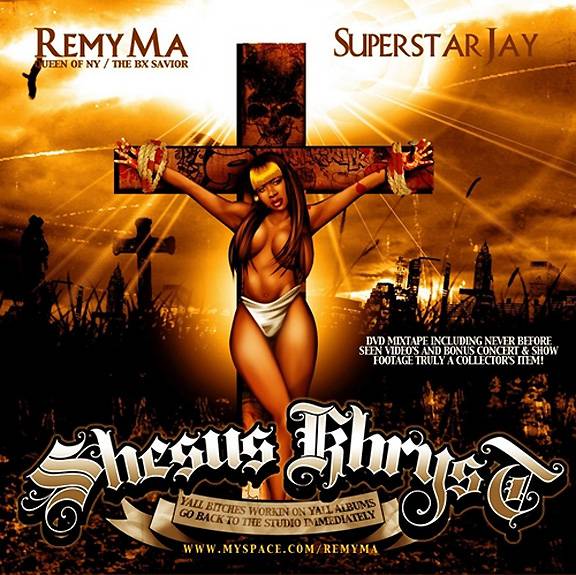
• Crucifixion earns “extra props”


If an rap artist has not struggled to obtain this, they are “commercial”, "pop" or “sellOUTS.” Paradoxically, credibility is diminished by SUCCESS.  (This was especially true during Hip Hop's Golden Era from 1987 to 1993).  What is the incentive to be anything else other than a "starving artist"? You must maintain the appearance of struggle even while succeeding.


_______________________________________________________________________

“Crack Music”

“Industry rule number 4080 / record company people are shady...”
A Tribe Called Quest “Check the Rhime”

But since the mid 1990s, making money off of Hip Hop has not only been accepted but it has all but become its singular focus.  So why are rap artists today still "starving"? Answer: bad business practices.

Often in rap music (and perhaps other popular art forms), this "struggling" Collective Consciousness creates a trend of bad business management and poor business decisions.

Follow how a rapper's path to success takes shape in this narrative:
• Artist as victim.  Faces lack of recognition, resources and stability.
• Organized money and institutions are the primary culprits along with fellow artists and unsupportive family and friends.
• Artists don't know how to do business and they are victims of labels, lawyers and finicky fans.

or conversely when a Hip Hop artist succeeds:
• Friends, family and community treat you differently
• Rappers feel uneasy and guilty about success
• Worse, they feel unsafe and about success (“watch your back”)

What develops is a “scarcity of success”; thus, the Hip Hop industry is:
• fiercely competitive
• artists hoard information and work in isolation
• record labels marketing "gimmicks" are actual lived experiences. This ensures a rapper's authenticity and artistic dominance

Despite all his success- or perhaps because of his success- Boosie Badazz is basically singing the blues:


Consider how the following "real life" situations are exploited by labels, media and / or the artist themselves.  For rappers especially, the line between "real life" and entertainment is blurred purposely.  This is nothing new to Hip Hop (or pop music) as the public criminal lives of Buskwick Bill, Slick Rick and Tupac all fueled record marketing strategies.

*Artist / Marketed Struggles and Events*
- Eminem / White, Addiction, Kim, Haley, Mom
- 50 Cent / Shot nine times
- Kanye / Car accident, Mom died, dumped by girlfriend
- Jay Z / Life of poverty, jail record, death of Auto-Tune
- Diddy / Biggie's death

The rapper Supa Sport is clear what trade gives him credibility as a rapper


If an artist commits to having credibility they accept being under acknowledged and underpaid because society doesn't “value” art with integrity. Thus, rappers who choose financial success often adopt “dumbed down” strategies. 

“Hustlers and boosters embrace me and the music I be makin / I dumbed down for my audience to double my dollars / They criticized me for it yet they all yell "HOLLA!" - Jay Z “Moment of Clarity"

While Jay-Z might have said that in 2003, ironically, as Jay-Z  career continues his elevated and celebrated status allows him the privilege of purusing Hip Hop that he  purposely identifies as "art". In the following video, he dances, raps and rubs elbows with some the most elite and renowned fine art painters and performers of our time:


Jay-Z might have established this "common sense" of scarcity and exploitation but he has left it behind in order to climb to higher heights. 

Perhaps there are limits to Rha Goddess' idea that success breeds failure in Hip Hop. To those interviewed in this mini-doc "Ice Cold: The Promise of Hip Hop Jewelry", flashing and flossing is precisely a sign of their success.


But the question the next section asks is what do rappers truly own and control in the Hip Hop culture industry?
_______________________________________________________________________

It’s Bigger Than Hip Hop

This Hip Hop Consciousness does not empower rappers and producers as their "artistic" practice is consumed by the machine of the music business.  A sampling of the forms of companies, services and careers the Hip Hop and Rap Music Industry is comprised of:

• Entities that seek to profit from the marketing and sales of rap music and its ancillary products.
• Record companies
• Music publishers
• Radio stations
• Record Stores
• Music video shows/channels
• Recording Studios (Owners, Engineers, Mixers)
• Performance Venues
• Booking Agents
• Promoters
• Managers, Accountants, Lawyers
• Disc Jockeys
• Music Publications
• Music/Entertainment Websites

What are some organizations or methods used to indirectly seek profit from Hip Hop?

The Hip Hop Industry is largely owned and operated by “elites” and not people of color. The “Big Four” Universal Music Group, Sony BMG, EMI Group, Warner Music Group account for 82% of US Music Market and 90% of the retail market in the 21st century’s first decade. There are no Black Americans in the top executive positions of these companies.  Rap record labels and “black entrepreneurs” like Diddy, Russell Simmons, Jay Z are actually “owned” by their Big Four “parent” company. 

Diddy, Simmons and others employ “perception management” to create the illusion of control over the content of the music.  Ultimately, these entrepreneurs make more money from clothing, liquor sales, car parts, etc. and other business ventures than they do from Hip Hop music and culture. Watch Lil' Flip's "struggle" to manage all the trappings of stardom.


The state of the Hip Hop Industry largely parallels the economic inequality African Americans face at in society at large; or as stated in the article by Jeff Smith, Hip Hop culture is "as broke as the communities that produced it."  With the synergistic relationship Hip Hop and R&B have had in the last 25 years, these “black” genre labels have re-categorized under the euphemism of “Urban Music” to make marketing of this product more palatable for "mainstream" tastes.  
_______________________________________________________________________

“Subliminal hypnotism and colonialism / leaves most niggaz dead or in prison”
- Jeru da Damaja “Return of the Crooklyn Dodgers”

Neo-colonialism: Forcing countries to consume what they do not produce and produce what they do not consume.  If the largest records and ancillary companies had but even a peripheral interest in the poor and the Black and Latino population rap music supposedly represents, then why would this rap "culture" be so overwhelming negative and self destructive?

Perhaps main stream rap's biggest audience is not even Black at all: According to Asante's referenced Forbes study: 45 million Hip Hop consumers between the ages of 13 and 34. 80% are White and have $1 trillion in spending power.

To quote Jay Z, truth be told, major label rappers have little to no ownership in this distribution, marketing and ultimate profit from their product.  The “Big Four” Universal Music Group, Sony BMG, EMI Group, Warner Music Group account for 82% of US Music Market and 90% of the retail market. There are no Black Americans in the top executive positions of these companies. Rap record labels and “black entrepreneurs” like Diddy, Russell Simmons, Jay Z give an illusion that the Hip Hop industry is "black owned" but the Big Four are really “parent” companies of the most prolific Hip Hop success stories. 

So the following questions must be clearly answered if we are to think that Hip Hop music is something more than disposable entertainment:

Who sponsors rap?
Who buys the most rap?
Who promotes death and violence?
Who backs ignorance?
Who exploits Hip Hop artists?
Who profits from “Black on Black” violence?
Who owns “urban” radio stations, television stations, print publications?

Mos Def's "freestyle" cut "The Rape Over" asks the same:


And, yet, Dame Dash and Cam'ron are held responsible in this interview:


“Commercial” Hip Hop is programmed by corporations that have little to no Black or ethnic representation despite peddling a product that purports to be “Black.” As a result the music:
• Has lost its edge
• Sense of rebellion and Black improvement
• The founding principles of artistry and empowerment

After the platinum successes of the low budget investments artists of the Golden Era, signed artists whose political agenda was in direct conflict with a record label's bottom line were dropped. The “Cop Killer” controversy accelerated this trend; the 2 Live Crew First Amendment “victory” certified that misogyny and Black on Black violence was a selling point.

“If skills sold, truth be told, I'd probably be / lyrically, Talib Kweli /
Truthfully I wanna rhyme like Common Sense / But I did five mill' 
- I ain't been rhymin like Common since”
- Jay Z “Moment of Clarity"

A trend of “corporate censorship” has developed where politically charged artists are marginalized by the label's “choice” on how to distribute the product.

Restriction of socio-poltical Hip Hop artistry can take the form of:
• Intimidation
• Budget Cutting
• Refusing to advertise or allow airtime
• Dropping “questionable” songs from final product
• Repackaging of artwork

Large record labels are practicing a policy of that seeks to make money off Hip Hop art and culture as long as it does not challenge the status quo in tone or content.

Plain and simple, Hip Hop artists do not own their music because they do not own the channels of production. Ownership of the music, distribution of the music and the final manufactured product are largely beyond a Hip Hop artist's control. Thus, the feeling of alienation is sustained in Hip Hop's collective consciousness.

The widespread dysfunctional reaction of rappers to seemingly all forms of marginalization is a dominate Hip Hop musical narrative that outlines mass consumption of material items, drugs, guns and women as some sort of defiant stance. There is no spiritual base or sense of peace or accomplishment as the Hip Hop artist is seeking internal serenity but only acquires external satisfaction.


Hip Hop music at it best is "Edutainment," food for thought over sublime beats. But its capacity to subvert norms and revolution communication and pop cultural expression so readily realized in the 1970s, 80s and 90s have been stunted.  Hip Hop "artists" and its audience may one day desire more than material success and it express themselves accordingly.  But likely, we won't call it Hip Hop anymore.